

What employers should know about disciplinary hearings, HR policies, and dismissal authority.
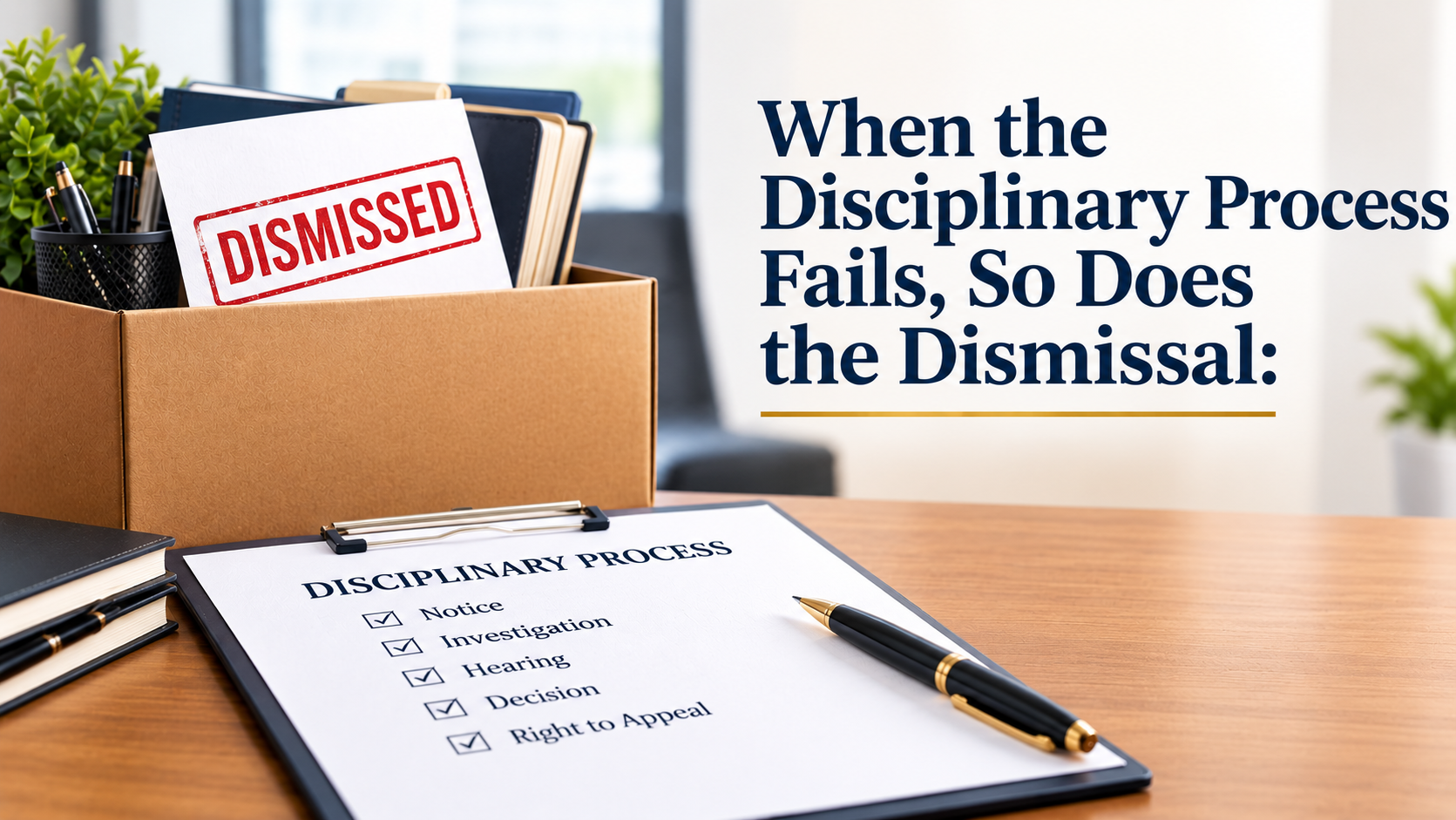
Having a valid reason to dismiss an employee is not enough. The Court of Appeal's decision in Consolidated Bank of Kenya Limited v Eustace Muchigiri Njuguna, Civil Appeal No. 274 of 2020; [2026] KECA 1386 (KLR), confirms that how a dismissal is carried out can be just as decisive as why.
The Case
A credit officer at Consolidated Bank was issued a show cause letter over irregularities in customer account management and appeared before a disciplinary committee, which recommended dismissal. According to the employee, the CEO later reviewed that recommendation and directed that he be allowed to resign instead. Despite this, the Head of HR signed and issued a summary dismissal letter.
The trial court found the dismissal unfair, awarding six months' salary plus one month's pay in lieu of notice. On appeal, the Court of Appeal upheld the finding of unfair dismissal and increased the notice award to three months (matching the employee's contractual notice period), but declined reinstatement given the more than three years that had elapsed.
Two independent failures
1. The reason for dismissal was never clearly established.
Section 43 of the Employment Act puts the burden on the employer to prove the reason for termination. The disciplinary minutes showed the committee and employee never resolved their disagreement over the allegations and the record didn't show how that gap was closed. A show cause letter alone doesn't prove a reason; the hearing record must show the allegations, the evidence, the employee's response, and the committee's findings and conclusion.
2. The wrong person signed the dismissal letter.
The Bank's own HR Manual reserved dismissal authority for such officers to the CEO; the Head of HR could only sign for unionisable staff, a category the employee didn't fall into. Signing outside that authority was ultra vires and, on its own, rendered the process unfair.
Why this matters to employers
Internal HR manuals, delegation frameworks, and disciplinary codes aren't just administrative paperwork as courts treat them as the procedure the employer is bound to follow. If policies specify who may approve or sign a dismissal, that authority should be respected, or any delegation properly documented. Informal instructions (like an alleged CEO directive) don't substitute for a documented decision trail: who decided, what was decided, when, under what authority, and who was authorized to communicate it.
Substantive and procedural fairness are also separate questions. Even genuine misconduct won't save a dismissal if the reason wasn't properly established, the employee wasn't fairly heard, or the decision wasn't made and signed by the right person.
The takeaway
If your organization has a disciplinary procedure, follow it. If your HR Manual allocates authority, respect it. And when you dismiss someone, the record should clearly show why, how, and by whom the decision was made because that record is what a court will judge you on.
A short compliance review before a dismissal is issued is almost always cheaper than defending one after it's challenged.
How We Can Help
We advise employers on the full lifecycle of disciplinary and termination processes , not just after a dispute has already arisen. Our support includes:
- Reviewing and drafting HR policies and disciplinary codes, including delegation-of-authority provisions, so it's clear who has power to discipline, dismiss, and sign termination letters.
- Advising on and chairing disciplinary hearings, to ensure the process, the record, and the findings will hold up to scrutiny.
- Pre-termination compliance checks, confirming the reason for dismissal is properly established and the correct decision-maker and signatory are involved before a letter goes out.
- Representing employers and employees in unfair termination claims before the Employment and Labor Relations Court.
- HR governance audits, identifying gaps between an organization's policies and its actual practice before they turn into liability.