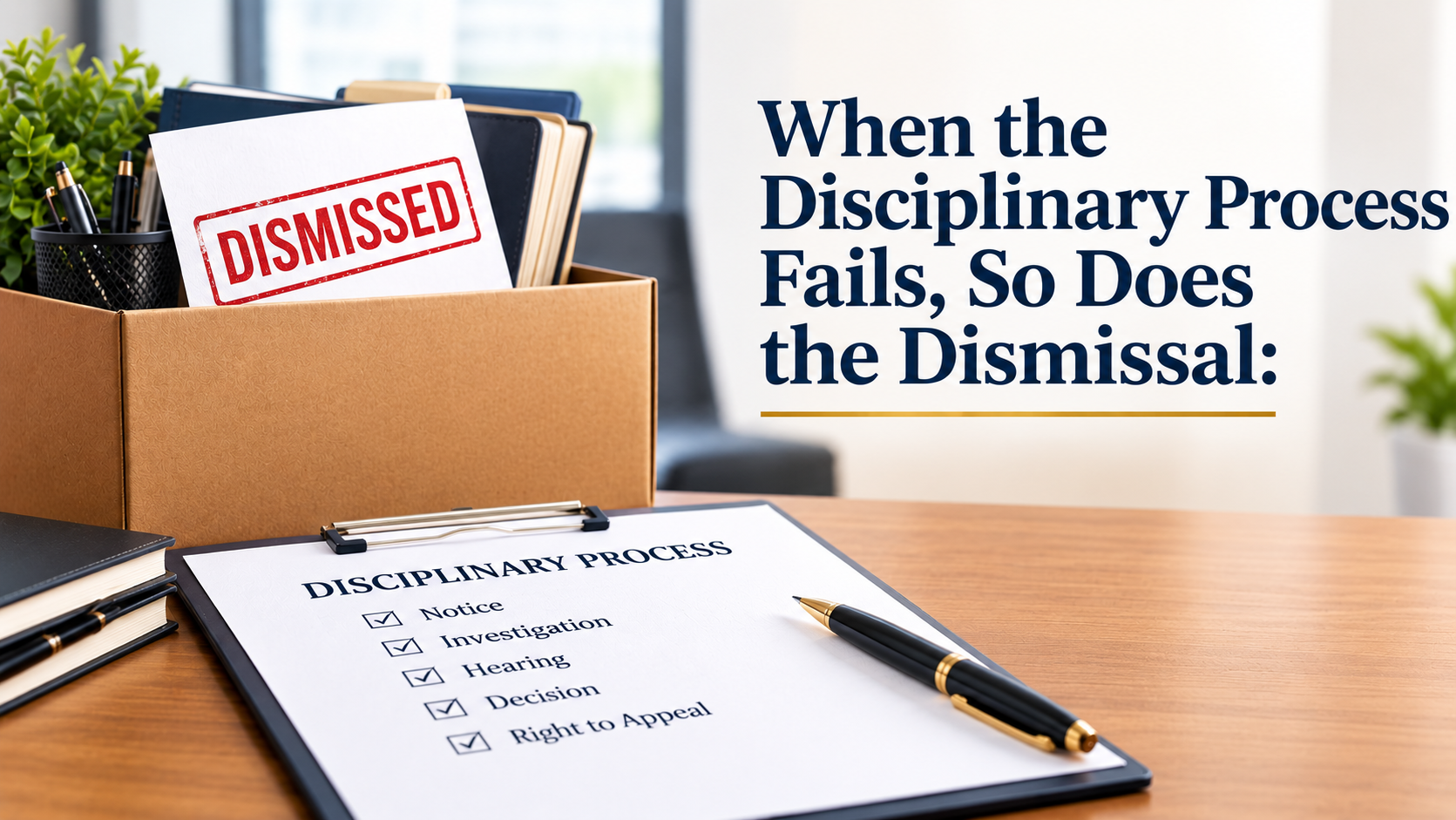
Case Analysis: Mosongo v Pathologists Lancet Kenya [2024] KEELRC 13313 (KLR)
An employer and an employee agree to part ways. They negotiate the terms. They sign a Mutual Separation Agreement. The employee receives an agreed exit package. The employer considers the matter closed and the employment relationship over, with no further claims to come.
Then, a few months later, the employee goes to court. He says the separation was never truly mutual. He says he was pressured into signing and that the employer had already made his working conditions untenable, leaving him with no real alternative but to leave.
The employer points to the signed agreement: "He agreed to go."
The Court asks a different question: Was the employee genuinely free to choose to leave, or had the employer's conduct already made continued employment untenable?
In Edwin Mosongo v Pathologists Lancet Kenya [2024] KEELRC 13313 (KLR), the Employment and Labour Relations Court found that what appeared on paper to be a mutual separation was, in substance, a constructive dismissal. The employer was left facing a judgment of Kshs. 5,877,227, plus interest and costs.
So what went wrong and more importantly, how can an employer enter into a mutual separation agreement without inadvertently creating the very conditions an employee can later point to as constructive dismissal?
The Case
Edwin Mosongo joined Pathologists Lancet Kenya in 2016 and rose to team leader in Sales and Marketing. By his account, things changed in 2022. He alleged that management began sidelining him, that his leave to care for his mother who was undergoing cancer treatment abroad was frustrated and that his bonus was withheld while he was quietly portrayed as underperforming.
Shortly after returning from leave, he was told the company wanted him out through a "mutual separation agreement," with little room, he alleged, to negotiate. He signed on 7 February 2022 and received Kshs. 1.3 million. Believing his exit had not truly been voluntary, he took the matter to court.
The employer's position was very different: it maintained Mosongo had underperformed, resisted new management directives, and that the separation and the Kshs. 1.3 million paid under it reflected a genuine, mutually agreed exit.
The Court's Reasoning: Labels Don't Decide the Case
The Court's key finding was simple but significant: calling an agreement "mutual" does not make it so.
Looking at the surrounding circumstances ,the undermined authority, the frustrated leave, the withheld bonus, and the pressured signing, the Court concluded that the workplace had become, in its words, "toxic, horrendous, and unpalatable," leaving Mosongo with no real choice but to exit. It held that the separation amounted to constructive, wrongful, unfair and unlawful termination.
This matters because it confirms that Kenyan courts will look past the document parties signed to what actually happened leading up to it. A signature is evidence of consent but it is not conclusive proof of it.
Three Principles Employers Should Take From This Case
1. Consent must be genuine and informed.
Where an employee is given no real time to consider an agreement, denied the chance to seek independent advice or pressured with an ultimatum, that undermines any argument that the separation was truly voluntary.
2. Performance concerns need a paper trail.
The employer's claim that the Claimant was a poor performer was not enough on its own. If performance is genuinely the reason for wanting someone to leave, there needs to be evidence: communicated standards, documented appraisals, identified deficiencies, and a real opportunity to improve — handled before separation, not asserted after the fact.
3. Separation agreements don't override the Employment Act.
Under section 45(2) of the Employment Act, 2007, termination must be both substantively fair (a valid reason) and procedurally fair (a fair process). A separation agreement cannot be used to sidestep these requirements where, in substance, the employer engineered the exit.
The Financial Stakes
The Court awarded the Claimant a total of Kshs. 5,877,227, comprising notice pay, accrued leave, six months' compensation for unlawful termination, and unpaid bonus — plus interest and costs. The employer's counterclaim to recover the Kshs. 1.3 million already paid was dismissed once the separation was found to be a constructive dismissal in substance.
The lesson: a poorly handled separation agreement is not a shield. It can become the very evidence used against the employer, while the payment made to "settle" the matter is not automatically returned.
Getting Separations Right
For a separation agreement to hold up, the process leading to it matters as much as the document itself. Employers should:
- Give employees genuine time to review and consider the agreement and not give an on-the-spot signature.
- Actively encourage independent legal advice and document that this opportunity was offered.
- Keep a clear record of negotiations, offers, and communications.
- Avoid ultimatums framed as "sign this or be dismissed."
- Address performance issues through a proper process before proposing separation not as a justification afterwards.
- Clearly settle all outstanding entitlements being among others salary, leave, bonus, and benefits within the agreement.
The Bottom Line
A mutual separation agreement should be exactly that: mutual. Genuine, negotiated exits remain a perfectly legitimate way to end an employment relationship. But where an employer creates an intolerable environment, predetermines the outcome, and pressures an employee into signing, a court is entitled to look beyond the label and find constructive dismissal — with significant financial consequences.
How We Can Help
If your organization is navigating an employee exit, or you want to review how your separation processes hold up against this standard, our Employment and Labour Law team can help you manage the transition without unnecessary legal exposure.